In modern industrial manufacturing, the stability of stamping dies directly determines the efficiency of the entire production line. As the "heart" of the die, the pressure status of nitrogen springs has long been a focal point for operations and maintenance personnel. As we enter 2026, with the maturation of Industrial Internet technologies, the era of relying on manual, experience-based inspections is fading away; instead, remote real-time monitoring solutions are becoming the key to enhancing production line reliability.
I. Why is Real-Time Monitoring of Nitrogen Springs Necessary?
In traditional production models, pressure loss in nitrogen springs often occurs "covertly." Should a specific spring suffer from insufficient pressure, it can lead to the following consequences:
Product Defects: Uneven forming of stamped parts and a rise in the scrap rate.
Die Damage: Unbalanced force distribution leading to abnormal wear and tear on the die.
Unplanned Downtime: Spring failure forcing a production line shutdown, resulting in high repair costs.
By utilizing a remote monitoring system, enterprises can shift from "reactive maintenance" to "preventive maintenance," gaining precise insight into the dynamic performance metrics of every set of nitrogen springs.
II. Core Components of a Remote Monitoring System
A mature solution for monitoring the "pressure health" of nitrogen springs typically consists of the following three components:
High-Precision Intelligent Sensors:
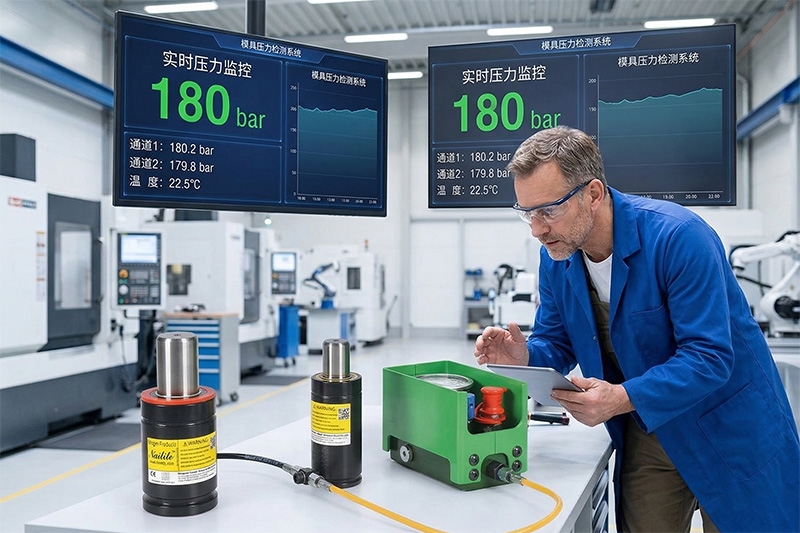
Pressure sensors installed on the nitrogen spring bases or control panels are capable of capturing critical data—such as pressure and temperature—in real time. These sensors feature excellent vibration resistance, making them well-suited for high-frequency stamping environments.
Data Transmission Module:
This module transmits the collected signals to a workshop gateway via wired or wireless connections. In the application scenarios of 2026, low-power, low-latency transmission technologies ensure the immediacy of data delivery.
Visualized Management Platform:
Operations and maintenance personnel can intuitively view the operational curves of all nitrogen springs via computers, mobile phones, or large-format workshop displays.
III. How to Achieve Precise Management of "Pressure Health"?
Real-Time Pressure Alerts:
The system allows for the configuration of upper and lower pressure thresholds. Should a reading deviate from the normal operating range, the system automatically issues alerts—via pop-up notifications, SMS, or email—prompting technicians to perform nitrogen replenishment or spring replacement *before* a failure occurs.
Dynamic Temperature Monitoring:
Nitrogen springs generate heat during high-frequency operation. By monitoring temperature fluctuations, it is possible to effectively assess the wear and tear of internal seals, thereby preventing seal failure caused by overheating.
Service Life Trend Analysis:
The system records the number of actuation cycles and pressure decay trends for each individual nitrogen spring. Through big data analytics, it predicts the remaining service life, assisting enterprises in scientifically formulating maintenance schedules.
IV. The Long-Term Value of Intelligent Upgrades
For both nitrogen spring manufacturers and end-users, the introduction of remote monitoring represents not merely a technological upgrade, but a fundamental transformation in management paradigms:
Data Transparency: Mold status is no longer a "black box"; production parameters are fully traceable and verifiable.
Resource Optimization: Spare parts inventory can be dynamically managed based on actual wear conditions, thereby minimizing excess stock accumulation.
Enhanced Delivery Capability: Stable equipment operation serves as the solid foundation for meeting high-standard delivery requirements.
Amidst the wave of digital transformation, nitrogen springs are no longer mere mechanical components; rather, they function as sensitive "touchpoints" within the intelligent manufacturing ecosystem. Nailite Nitrogen Springs is a brand owned by Dongguan Tengfei Hardware & Mold Co., Ltd.—a technology-driven enterprise dedicated to the integrated R&D, manufacturing, sales, and service of nitrogen springs (including robotic counterbalance cylinders). Our products hold numerous national patents and EU certifications, and are exported to countries and regions across the globe. We welcome your inquiries; please contact Ms. Zhou at +86-13922516997.